|
|||
Juniors in denialEric Hommelberg Note: This piece replaces the last week announced chapter VIII of the Gold drivers 2005 report "Gold & Investment opportunities in Gold Mining/Exploration companies". This piece has a strong focus on present situation. However 80% of presented material here will find its way into chapter VIII of the report. A preview of the report can be found here. Readers interested in the entire report can drop a mail. I'll send the entire report in pdf format around mid December. END. Strange world today! While gold is making a 16-year high, many junior mining companies are struggling to bounce off their year-low these days. How come you may wonder, weren't they supposed to rise faster as their senior brothers on rising Gold prices? Weren't they supposed to be "an once in your lifetime opportunity?" How to explain the lack of excitement these days regarding juniors? Will they recover? How is this going to end? So what to do now? Sell, Hold or Buy? The main problem here is that many investors are counting on a severe correction in the price of Gold and therefore started selling their Gold shares. However, the liquidity in junior gold mining shares is so small that they simply can't absorb the generated selling pressure. What happens next is a rapid decline in the junior shares (lack of bids) thereby confusing many shareholders. When the selling pressure continues confusion turns into fear and further down the road into panic. The result can be a dramatic waterfall sell-off. I wrote this piece in order to show investors that it won't be such a clever deal imo to sell your junior mining shares right now. It's my strong believe that looking back in a few years time at this period (Q4-04) when Gold was at the verge of breaking its 16-year high of $430 and on its way to $500 that people will wonder how they could be so stupid to sell junior shares at these historic lows. So the main question here is: Are the Juniors on a launch pad now and should I invest accordingly? Well, let us examine the question first of why to invest in junior mining companies at all. Why to invest in Junior Mining companies Since the start of the current
bull market in Gold in 2001 the Gold share index HUI appreciated
by more than 600%. Still lot of denial does exist among fund
managers regarding the strength of this current bull. It seems
that the first phase of this bull market in Gold (which was characterized
by denial) is in its latest stage and phase two (which will be
characterized by acceptance) will be launched by slashing Gold's
16-year high of $430. Expect some serious inflow of investment
capital during this second phase of the bull market in Gold and
watch out what will happen with the high quality junior mining
firms. They can go ballistic but it requires a stomach of steel
in order to keep them during severe corrections. They tend to
rise faster as their senior brothers but also the opposite is
true, they fall much harder during corrections. Is an investment
in a junior mining firm extremely risky as some people want you
to believe? Well, Ian Gordon (vice president of Canacord Capital
and editor of the long Wave Analyst) gave some presentations
in Europe lately in order to promote the investment opportunities
in junior mining firms. "Investing in Junior Gold Mining Shares. What risk? What reward?" He clearly pointed out that
an investment made today in a high quality junior mining firm
should not be categorized as being a high risk investment. Why
not? Because you'll buy them at historic low levels today thereby
reducing the downside risk towards a minimum. (of course he refers
to a multi-year time span and not the short term volatility which
can be extreme.) So what makes the juniors so special then? Well, the reason is twofold. First of all the senior producers will go after them so why won't you as an investor do the same? Second is that Juniors tend to rise very fast on rising Gold prices but as said before also the opposite is true, they'll drop much faster during severe corrections and thus subject to extreme volatility. Let us focus on these characteristics by answering the following:
Juniors & declining gold reserves. Why should they benefit? As mentioned above world wide declining gold reserves will benefit the juniors because their senior brothers will go after them. But why are the senior producers hunting for them? Because the Gold industry is facing a decline in Gold production coming years and the senior gold producers will be struggling in order to replace their dwindling gold reserves. So how bad is this situation really? Alex Davidson (Vice President Exploration Barrick Gold) said last year: "Big mining companies need to spend more on exploration, or else, at current annual production rates, reserves will be depleted in 10 years, he said. It can take six to eight years between making a discovery and starting mine production, and "we're not currently funding exploration at a level required to replace reserves," It seems that the awareness of a dwindling Gold supply is growing these days. Dow Jones News Service reported on Nov 10: "Merrill Lynch Investment Managers have a favorable outlook for gold, underpinned primarily by emerging pressures on supply". Merill Gold fund manager Evy Hambro said: "We've got a situation where the mined production of gold is going to be declining for the foreseeable future,". END. Further more Hambro said that falling mine output over the coming years was one of the reasons to to prolong the rally in U.S. dollar gold prices. Hambro is not a crank, his seven-member team is one of the world's largest managers of gold equity investments, overseeing about US$6.5 billion spread between several mining funds. The main reason for this situation to exist was a lack of Exploration during the 1997 2002 period. Exploration budgets had been slashed by 67% during this period. Fortunately the Exploration sector attracted more investment capital again since 2003 but the sad truth is that it doesn't matter how much money you'll throw at Exploration, no matter what the Gold price is, it still takes three to five five years from scratch before a big discovery can be made and after that it still takes four to seven years before a mine can be opened in order to mine the new discovery. Newmont president Pierre Lassonde said (August 2003): "The 20-year
bear market in gold has weeded out marginal gold producers and
significantly curbed exploration and production.". "If
gold was $1,000 an ounce, it still takes four to seven years
to open a mine," END. "The average lead time for a large discovery to go on-stream with production was around five to seven years but that seven to 10 years was probably more realistic. ". "The industry isn't going to be able to respond immediately to higher gold prices. It is going to take a long time." END. Trevor Steel, partner at Baker Steel Capital Managers told delegates at a two-day Euromoney gold seminar recently: "The way I like to think of it is that the gold industry is in overdraft. It's been relying very much on discoveries that were made many, many years ago and it is not replacing the reserves it is mining every year," Despite this, Steele said the industry needed to spend more money on exploration to find big enough deposits to replace production. "It is going to be a major challenge for the majors . . . yes of course they can acquire, but they all want to find the large assets and there just aren't that many of them around." Paul Burton, editor of World Gold said: "But the industry needs major new finds to replenish the inventory pipeline. What we need to reinvigorate the industry is some major new finds. Such discoveries are rare."END. Let's repeat the last sentence here: "What we need to reinvigorate the industry is some major new finds. Such discoveries are rare." Indeed, such discoveries are rare. According to Alex Davidson (Vice President Exploration Barrick) only a very few major deposits (5+ million ounce) have been discovered since 1999. It should be obvious by now that the Gold industry is desperate for new major discoveries. But where to find them? Remember that 75% of all discoveries are made by junior mining companies so it ain't difficult to understand where the big producers are heading to. The trend is obvious: Barrick opened an office earlier this year in Vancouver in order to monitor Junior companies. "Barrick Gold's New Office Tracks Junior Exploration Cos." "Barrick Gold Corp. (NYSE:ABX) has opened a Vancouver office to monitor junior exploration projects, executive vice-president Alex Davidson said at an exploration conference. Davidson said two or three employees in the office are tracking junior projects, and visiting managers of companies and their exploration sites. The local office also handles Barrick's exploration efforts around Eskay Creek, its 100%-owned gold mine in northern B.C." And what about Anglogold? AngloGold CEO Bobby Godsell said: "It is the end of big picture gold consolidation; there is no compelling logic to combining anymore. The real challenge now is how to replace your ounces for the future." The race to replace ounces is about to begin. It will take the form of takeovers of small producers with long reserve lives and high quality junior mining companies with large in ground reserves that can be mined economically." END. A few month later these thoughts were echoed by Sam Jonah, the company president: Where will AngloGold buy
next? "We will look at juniors that have attractive assets in there portfolios and require our expertise and capital to move these projects forward." END. And what about Newmont? Are
they interested in Juniors? Well, it seems they are! They took
an interest in Gabriel Resources Ltd. So what happened to its
share price? It shot up by 54%! Juniors & the price of Gold. What influence? The primary key driver for Gold Mining equities remains of course the price of Gold. Make no mistake about it, without higher gold prices there won't be any excitement in this sector. So higher gold prices will do the trick, but when to expect excitement really to kick in? That's difficult to answer but my intake is this. First of all you should ask yourself if you're convinced of higher Gold prices down the road. No bull market in Gold means no bull market in Gold mining equities. It's that simple. I think that we're in a bull market in Gold for reasons well documented in my piece "Gold drivers 2005 preview" which can be found here. If you agree to be in a Gold bull market then you should analyze where we exactly are in this bull market and how much further potential we may have got. Any secular bull market can be divided into three stages. The first stage is being characterized by climbing a wall off worry and denial. The second stage will be characterized by acceptance and large inflow of institutional investment capital. The third stage will be characterized by mania. It's my strong believe that we are at the end of stage one of this bull market in Gold and on the verge of entering stage two. When Gold's 16-year high of $430 will be slashed definitely investors will realize that this bull market in Gold is for real and excitement can kick in very fast. But are we going to slash the $430 level now or do we have to face another Gold ambush and watch the shares going down again? Well, we're at a critical juncture here, indeed some analysts warning for a correction now, some analysts even calling in a top of a three year bear-market rally (Prechter) and expect Gold to fall below $300 again while on the other hand some analysts are calling for an accelerated move towards $500. You see, confusion is all over the place in the Gold market these days which makes investors to decide to step aside from the gold market for a while. Let us focus now on today's situation. It reminds me of December 2002 when Gold was struggling in order to break its long term resistance of $325. The same skepticism was being felt as we're witnessing today. When the $325 resistance was taken out the formation of a teacup with handle was completed and Gold took off. The following chart was published by Mr. Jim Sinclair on December 13 2002. 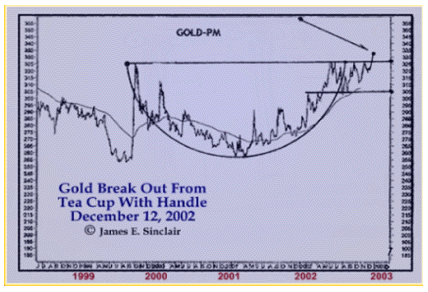 Mr James Sinclair furthermore wrote: "This is a momentous occasion and something you may not see again technically in your trading career. Not only is it rare to see this formation, but rarer even to see any formation with such symmetry. The more symmetrical a formation is, the more meaningful it is. The longer it takes to construct a rare formation like this, the more meaningful the formation is." "I suggest you save the chart given to you this evening on the technical review. In your career, whenever you see this again, in anything, you will know what to do." END. That was December 2002. Mr. James Sinclair was right. Gold took off all the way up from $325 to $390 in a short period of time (less than two months). Why do I come with the December 2002 teacup formation? Well, because we are completing just right now another teacup with handle formation and therefore I want to repeat Mr. James Sinclair's statement from December 2002: In your career, whenever you see this again, in anything, you will know what to do. Sure, Mr. James Sinclair brought the current teacup formation to his subscribers' attention last month by publishing the following chart: 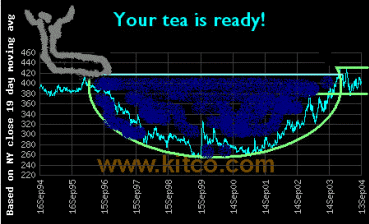 What should be obvious by now is that you'll recognize the importance of the $430 resistance. When it breaks, a rapid launch towards the $500 mark isn't unthinkable. The following chart illustrates the importance of the $430 resistance level from a very long term perspective. 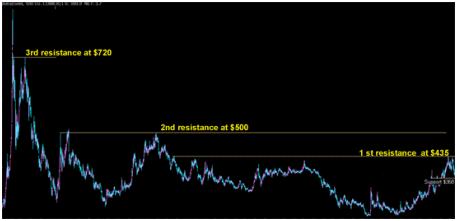 So here we do have a completed teacup with handle formation projecting a rapid rise towards the $500 mark which is confirmed by the long term chart of Gold as well. What's needed now is a decisive break of the $430 - $435 resistance. As I said, a rapid rise towards the $500 mark is not unthinkable. James Turk of goldmoney.com publicly says to expect Gold to hit $500 by year end. No, this is not a misprint, he expects Gold to hit $500 by year end. In his latest piece "The Buck drops here" (Nov 10) he wrote: "In fact, gold looks like a rocket just starting to launch. Ignition occurred on Friday, October 29th when gold closed at 16-year weekly and monthly highs. Lift-off is now just beginning. As can be seen from the above chart, gold is moving off of its launch pad by breaking above the horizontal, dashed red line. But just as importantly, we can see from this chart that $500 is not a moon-shot away, but rather just a short chip-shot. Let's see how long it takes gold to reach that level. As I noted in my recent interview in Barron's, which has the same title as this alert, I expect gold to be at $500 by the end of this year, or early next year at the latest." END. http://www.goldmoney.com/en/commentary.php So what happens if Gold breaks its 16-year high of $430 level definitely? Again, the bull market in Gold will gain much more acceptance and investment capital will find its way into the Gold mining sector. But here is the problem, the entire Gold mining sector is so small that this sector will simply explode when serious investment capital is heading towards the Gold mining sector. We saw that happen last time when serious investment capital was heading towards the Gold mining sector in 1996, the XAU index was on a launch pad to 150 and many junior companies appreciated multiples of 100%. The chart below shows perfectly clear what kind of wonders a rapid rise of the Gold price could do for a junior but it also shows what kind of disaster a declining price of Gold can cause. The chart presented here is from a typical junior Gold Mining/Exploration company. 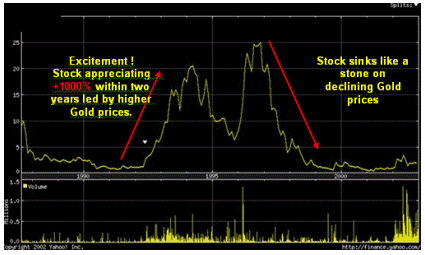 That was 1996 but unfortunately the rapid rise in the price of Gold back then is written down in history books as a bear market really. Now fast forward to present situation. The current bull market in Gold started in 2001 and yes, the year of 2003 showed some renewed interest for the gold mining equities as well but still many investors are anxious to get in. That will change when Gold is marching towards the $500 mark. Highlights
To junior investors I would say: Get used to the high volatility surrounding the junior sector. Just hold your shares and let them do their Exploration. That's why you should have bought them in the first place, not for short term speculation. Give them the time needed to complete their Exploration programs. Yes, your shares will be subject to sudden panic sell offs in the future again, that's all in the game but they'll recover just as they recovered from previous panic sell offs. Why? Because we're in a bull market in gold. The big move in junior mining stocks is still ahead of us. Eric Hommelberg |